
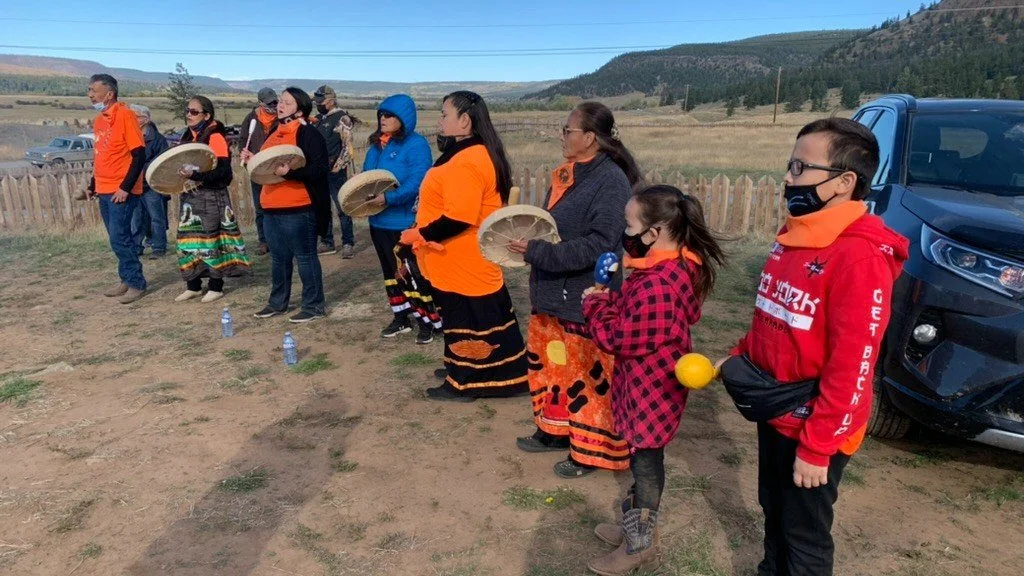
September 30, 2021 - Orange Shirt Day ceremony in Tl'etinqox
Dallas Brodie, MLA
As we approach another National Day for Truth and Reconciliation, I have been thinking a lot about truth.
Not only about what Canadians have been asked to confront about residential schools, the removal of Indigenous children from their families and communities, and the laws and policies that sought to erase Indigenous cultures and ways of life through colonialism, but about something much more human:
What happens inside us when we encounter a truth that challenges not only what we believe, but something fundamental about who we believe ourselves to be?
I am an Indigenous woman. My mother is a residential school survivor. My husband spent nine years in Indian Day School. For over 6 generations, members of my family were required to attend residential schools. I am 42 years old and the first generation in my family who was not.
And now I am a mother.
Our son is growing up with a profoundly different relationship to school than his grandmother and his father experienced.
So, when I hear the public conversations about residential schools become arguments over terminology, numbers, evidence and what has or has not yet been physically confirmed at particular sites, I cannot experience these as abstract political arguments.
These are our families. Our mothers and fathers. Our grandparents.
These are the experiences that shaped the people who raised us and, consequently, shaped us.
But I don't want to answer your arguments with another argument.
Instead, I want to offer you an invitation.
What would happen, Dallas, if you asked yourself a different question?
Not: How can I prove that I am right?
Not: Where is the evidence that proves someone else is wrong?
But simply:
What if this is true?
I want to be clear about what I mean by that question. The broad history of the residential school system is not a matter of speculation. It has been documented through records, testimony, inquiries and the words of thousands of survivors. But knowing that evidence exists and being willing to let it challenge what we believe are not always the same thing.
What if the thousands of survivors telling us what happened to them are telling the truth?
What if the families describing generations of loss, violence, disconnection and trauma are telling the truth?
What if there are dimensions of this history and of Indigenous experience in this country that you do not yet understand? There is no shame in not knowing everything. None of us do. The question is what we do when we encounter something that unsettles what we thought we knew.
What if part of the legacy of these systems is the distance created between us; a distance that still makes it easier to argue about one another than to recognize our shared humanity?
And then perhaps the harder question:
If it is true, what does it require you to confront within yourself?
I don’t ask that question only of you.
I ask it of myself, of governments and corporations and institutions.
I ask it of all Canadians.
Because it would be too easy to make this only about you. The harder work is asking whether each of us is as willing to question our own certainty as we are to question someone else’s.
I am increasingly convinced that one of the greatest challenges is not simply whether we can find the truth.
Much of the truth is already available to us.
The question is whether we are willing to face it; and whether we are willing to let what we learn change us.
Human beings are complicated. We are shaped by our families, our histories, our experiences and our fears. I deeply believe in making room for that complexity.
I can honour someone’s humanity and try to understand the experiences that shaped their beliefs.
But understanding is not the same as excusing harm, and compassion does not absolve us of accountability.
And truth cannot only be something we demand from other people.
We must be willing to let it in, too.
I know something about how difficult that can be.
There have been truths in my own life about my family, my country and myself, that I desperately wished were different.
Some arrived gently.
Others did not.
But I have learned that denying a painful truth does not make it less true.
Defending ourselves against it does not make it disappear.
And attacking the person who speaks it does not relieve us of the responsibility to reckon with it.
Change within us can only begin when we are willing to sit with the possibility:
What if this is true?
And then:
What must I do differently because I now know?
That is the invitation I offer you this September 30, Dallas.
Not to surrender your capacity for critical thought.
Not to stop asking questions.
Questions matter. Evidence matters. But genuine truth-seeking asks something of the person asking the questions too.
Perhaps truth-seeking sometimes requires something more difficult than questioning other people’s accounts.
Perhaps it requires questioning our own certainty.
There is a difference between saying, “I don’t know enough yet,” and deciding that unless every detail can be proven to our satisfaction, we are entitled to dismiss the larger history. The first leaves room for learning. The second can become a way of protecting ourselves from what we do not want to know.
My son is still very young. I think often about the Canada that he and his generation will inherit.
I want something better for him — and for all children, Indigenous and non-Indigenous.
I want them to inherit a country capable of telling the truth about itself without collapsing into defensiveness.
A country mature enough to hold painful history and still imagine a different future.
A country where reconciliation does not require agreement on every issue, but does require the courage to remain in relationship while confronting difficult truths.
Perhaps that is part of what September 30th is asking of us. Not only that we remember, but that we ask what we are prepared to do with what we know now.
None of us is personally responsible for creating the history we inherited.
But we are responsible for what we choose to leave behind.
My mother experienced school one way, my husband experienced it another. My son has the possibility of experiencing something profoundly different. The difference did not happen because the past disappeared. It happened because people were willing to confront it and insist that something change.
And perhaps that responsibility begins with one deceptively simple question:
What if it is true?
My hope for all of us — including you, Dallas — is that the generations coming behind one day look back and say:
They learned the truth.
They faced it.
And rather than running from it, defending against it or diminishing those who carried it, they allowed the truth to change them.
May we be remembered as the generation that allowed the truth to change us.